
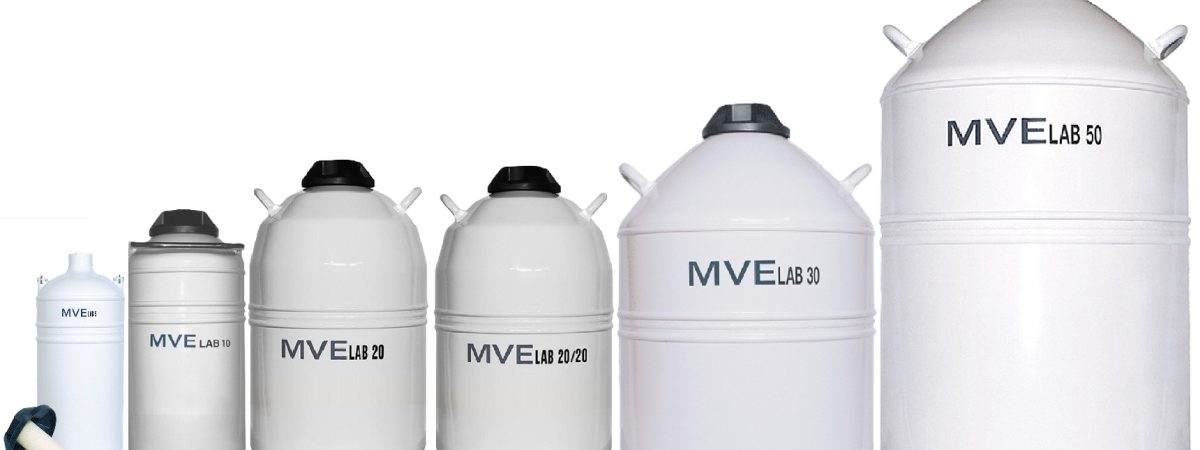
Cryosurgery looks simple on the surface; however, what makes these results consistent and reliable is how the liquid nitrogen is stored and handled.
Below are the risks of using inadequate liquid nitrogen storage containers:
- Inconsistent freezing results
- Higher operational costs
- Safety issues for staff
- Interrupted procedures
That’s why choosing the right liquid nitrogen storage system is important. It directly affects treatment quality, clinic efficiency, and long-term costs.
In this guide, we break down the best liquid nitrogen storage containers for cryosurgery.
What is a liquid nitrogen storage container in cryosurgery?
A liquid nitrogen storage container is a specialized vessel designed to store liquid nitrogen at ultra-low temperatures (-196°C) without rapid evaporation.
It acts as the primary supply source in cryosurgery. It keeps the nitrogen stable and safe until it’s needed during procedures.
Even the best equipment can’t deliver consistent results without proper storage. Once you fix that, you’ll wonder why you didn’t upgrade sooner. Check out our liquid nitrogen storage systems to choose the right one for your clinic.
What are the risks of poor storage of liquid nitrogen in clinics?
Many clinics underestimate the impact, but poor storage leads to:
Faster evaporation → more frequent refills and higher costs
Temperature fluctuations → inconsistent treatment outcomes
Operational delays → interruptions during procedures
Safety risks → pressure build-up or improper handling
Good storage, on the other hand, is essential for predictable performance. It reduces gas wastage and ensures hassle-free daily operations.
Good vs Bad Liquid Nitrogen Storage in Cryosurgery
| Factor | Poor Storage System | Proper Storage System |
| Nitrogen Retention | Needs frequent refills | Reduces evaporation and saves cost |
| Treatment Consistency | Temperature fluctuations and uneven results | Predictable outcomes |
| Operational Efficiency | Delays in procedures | No unexpected downtime |
| Cost Impact | Higher long-term costs | Lowers overall expenses |
| Safety | Risk of pressure build-up | Safe handling and controlled storage |
| Clinic Performance | Unreliable procedures | Reliable performance |
Quick takeaway:
Good storage directly impacts how your clinic runs day to day. Fewer refills, smoother procedures, and no last-minute surprises during treatments cut unnecessary costs.
What are the best liquid nitrogen storage containers for cryosurgery in 2026?
Here are some of the most reliable options currently used in dermatology and general practice clinics:
Best for: Low-to-moderate usage in small clinics
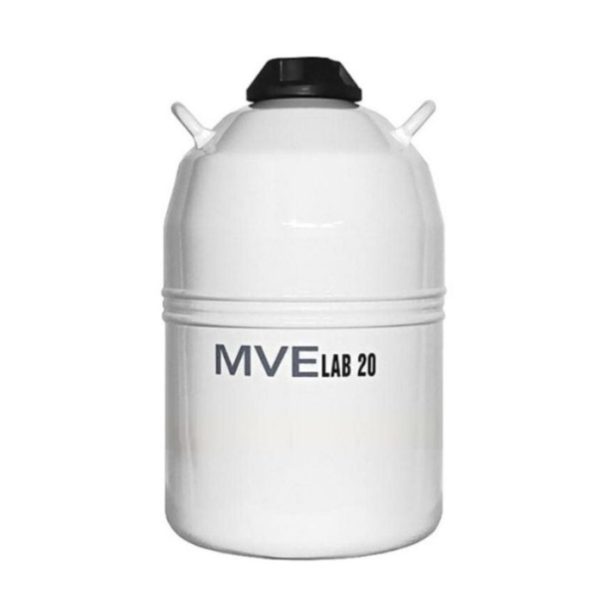
The Brymill MVE LAB 20 is a compact dewar built for clinics that need reliability without adding bulk to their setup. It’s part of Brymill’s well-known lineup, often considered a go-to standard for liquid nitrogen storage in clinical environments.
Clinics choose it because:
- It has a 20-liter capacity
- Weighs about 53 lbs. (full)
- Easy to carry and reposition
- Efficient insulation for its size
- Comes with a 3-year warranty
- Ideal for daily dermatology procedures
When it works best:
If your clinic performs cryosurgery a few times a day, this model gives you enough capacity without over-investing.
Best for: Medium to high patient volume
The Brymill MVE LAB 30 is a solid step up when your clinic starts handling more frequent cryosurgery procedures. It gives you more storage and longer hold time.
What makes it work well for busy setups:
- 30-liter capacity, so no constant refilling required
- 14–16 weeks static holding time to keep things stable over weeks
- Static evaporation of 0.22 liters/day for continuous usage
- Insulated cap included
- Comes with a 3-year warranty
When it works best:
It is best for managing regular cryosurgery cases. Multiple practitioners can also choose this for a steady, reliable supply without constant refilling.
So far, we’ve looked at LN2 storage systems which are only one part of the setup. Once you’re in the treatment room, efficient application of the liquid nitrogen is equally important.
This is where things shift from storage to execution.
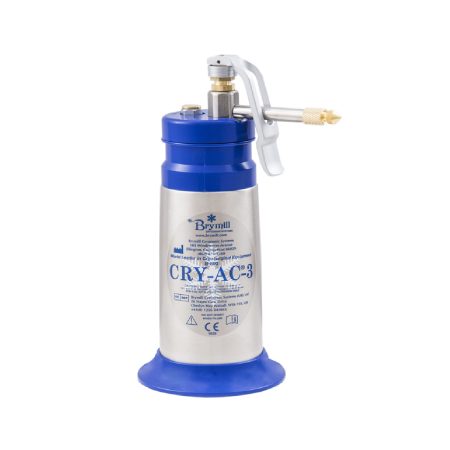
Clinics use cryosurgical sprayers for the required control and consistency. Brymill B800 Cry-Ac 3 (10oz) Cryosurgical Sprayer is best for controlled, precision-based treatments.
This is one of the most commonly used handheld sprayers in dermatology because it comes with 5 spray tips with varying-sized apertures for controlled operation.
Why it stands out:
- Fine control over spray intensity with its slender fingertip trigger
- Lightweight and easy to maneuver
- Patented Safety Auto Vent
- Polypropylene cover and collar insulates
- Durable stainless steel and brass construction
- Suitable for small lesions and targeted treatments
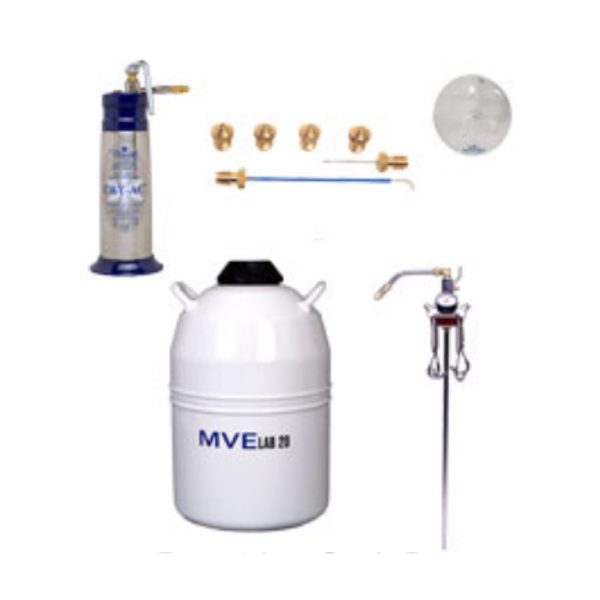
Some clinics prefer a more complete setup instead of standalone sprayers and storage systems. Let’s look at the 16 oz Brymill BRY-1003 Dermatology Package, which is a complete cryosurgery package designed for clinical use.
This package is designed for professionals who need longer procedure time without interruptions.
Key advantages:
- Larger capacity sprayer
- Consistent spray performance
- Designed for extended sessions
- Up to 24 hours of sprayer static holding time
- 12 weeks of tank static holding time
What’s included in the package:
- CRY-AC sprayer – 16 oz capacity
- Withdrawal device (designed for dermatology practice)
- 20-liter liquid nitrogen dewar
- Cryoplate
- 5 spray tips
- 1 bent spray aperture
When is the Brymill Dermatology Package ideal for you?
The complete liquid nitrogen storage package by Brymill is suitable if you handle regular dermatology procedures and you need a setup that keeps up without constant refilling or adjustments.
Best for: Clinics offering occasional cryosurgery
This is a ready-to-use setup with a 10 oz CRY-AC3 sprayer, 20/20 dewar, and essential accessories. The sprayer holds for 10–12 hours, while the tank offers up to 220 days of holding time. It is ideal for infrequent use and backed by Brymill’s trusted build quality and a 3-year warranty. It is a reliable choice for clinics that need consistency without overcomplication.
Why it works:
- Simple and easy to use
- Lower investment
- Covers basic treatment needs
- Brymill BRY-1001 Family Practice Package (16 oz)
Best for: Clinics scaling their cryosurgery services
This is a step up from the 10-oz version. It is the gold standard in LN2 equipment and gives you more flexibility during procedures.
What improves:
- Comes with a 20/20 Dewar with a 220-day holding time
- Fewer interruptions during treatments
- 5 spray tips and 1 bent spray aperture are better suited for multiple patients
- Cyro plate for a more efficient workflow
What is the difference between a dewar and a cryosurgical device?
A dewar is where the liquid nitrogen is kept stable at extremely low temperatures. The cryosurgical sprayer is used during treatment. In simple terms, the dewar is the storage tank, and the sprayer is the tool that delivers it. You will need both to make a complete cryosurgery setup.
How do you choose the right liquid nitrogen storage container?
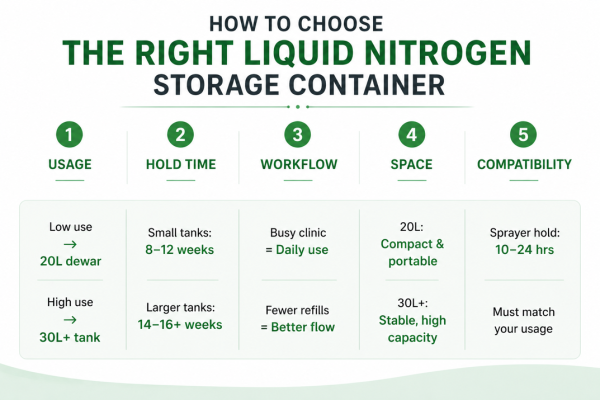
Focus on these factors to pick the ideal LN2 storage solution for your clinic.
- Daily usage
If you are performing cryosurgery frequently, you will need a larger tank, but a smaller dewar is suitable for low usage.
- Hold time
Better insulation means nitrogen lasts longer. So, choose one that reduces refill frequency.
- Clinic workflow
Busy clinics need systems that reduce interruptions.
- Space and mobility
Compact designs are better if your setup is tight or mobile.
- Equipment compatibility
Your storage container and sprayer should work seamlessly together.
How long does liquid nitrogen last in a dewar?
Liquid nitrogen doesn’t last the same in every setup. It depends on how big the dewar is and how well it is insulated. Smaller ones might get you through a few days or maybe a couple of weeks. Mid-sized tanks usually last a bit longer, while larger systems can stretch for months.
Which setup is best for your clinic?
Here’s a simple way to decide:
Small clinic / low usage:
Growing clinic / moderate usage:
High-volume clinic:
MVE LAB 30 + BRY-1001 or BRY-1003 package
Don’t Forget your roller bases for storage containers 20 liters and over. For 20 Liter Liquid N2 storage containers use 20 Liter Liquid N2 Storage Container Roller Base
For 30- and 50-Liter Liquid N2 Storage Containers use 30 and 50 Liter Liquid N2 Storage Container Roller Base
If you are using the 502 Liquid N2 Withdrawal Device, you will need to have two Liquid N2 Storage containers to maintain maximum efficiency and high-volume use. The busiest dermatology offices commonly use this scenario for their Liquid N2 setup. This is because the 502 Liquid N2 Withdrawal Device can take up to 24 hours to build adequate pressure.
Final Thoughts
Most clinics focus heavily on treatment techniques but overlook the system behind it. In reality, better storage leads to better performance.
If you’re planning to upgrade, it helps to work with a supplier that actually covers every use case. With Broward A&C Medical Gas Specialists, you’ll find a complete range of Brymill liquid nitrogen storage solutions. We offer everything, ranging from a compact model for low usage or high-capacity systems for busy clinics. All Brymill products come with a 3-year warranty, and with an extensive stock available, you are not stuck waiting or compromising on the right fit.
Take a look at the full cryosurgery range and choose a setup that matches how your clinic actually operates.
FAQs
What is the best liquid nitrogen storage container for cryosurgery?
Some clinics have light usage so they will find a smaller, easy-to-handle dewar like the Brymill MVE LAB 20 suitable for the job. But for higher patient flow, bigger models like the Brymill MVE LAB 30 paired with a cryosurgical sprayer can be accurate during treatments.
Can liquid nitrogen be stored in any container?
No, it must be stored in specially designed dewars that can handle extremely low temperatures and prevent pressure build-up.
What size liquid nitrogen tank do I need?
It depends on usage. Small clinics can use 20-liter dewars, while busy clinics often require 30 liters or more.
Is a cryosurgical sprayer necessary?
Yes, it ensures controlled and accurate application during procedures.
How often will you actually need to top up your liquid nitrogen tank?
The frequency of use and the size of your tank determine the refill schedule. Some setups need a refill every week, others can go a few weeks or even a month.

Recent Comments